![]() |
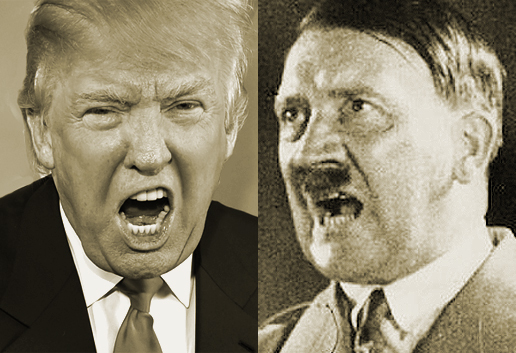
| "EVERYONE knows… they're BAD people… I alone can fix it. |
Tuesday, October 18, 2016
Deplorable Language
Saturday, August 11, 2012
Hitler and Churchill: Watercolorists
![]() |
| Villain, Hero, Artistic Argument |
Hitler: Make the painting big, make it simple, and eventually it becomes a cultural icon.
Churchill: Painting a picture is like trying to fight a battle.
Hitler: As for the degenerate artists, I forbid them to force their so-called experiences upon the public. If they do see fields blue, they are deranged, and should go to an asylum. If they only pretend to see them blue, they are criminals, and should go to prison. I will purge the nation of them.
Churchill: I cannot pretend to be impartial about the colors. I rejoice with the brilliant ones, and am genuinely sorry for the poor browns.
Hitler: Germany will either be a world power or will not be at all. The great strength of the totalitarian state is that it forces those who fear it to imitate it.
Churchill: At one side of the palette there is white, at the other black; and neither is ever used neat.
Hitler: I am an artist, not a politician. I want to end my life as an artist.
Churchill: When I die and go to heaven, I want to spend the first million years painting – so I can get to the bottom of the subject.
_________
Voice-over
Hitler and Churchill.
One was a villain.
One was a hero.
Together they created the epic of a terrible war.
Some might argue that, just as police and criminals are opposite sides of the same coin, Hitler and Churchill had a lot in common (for a comparison and contrast of the two go here).
But looking at Hitler’s and Churchill’s pronouncements about art, it is clear that Hitler had a totalitarian view of art whereas Churchill, for all his forthright prose, approached art as a challenge in the arena of democracy.
…
Sunday, December 7, 2008
Two cheers for Democracy

As they cross the bridge, Narong and Vijay discuss what democracy means.
Narong: Democracy? Majority rule, I guess.
Vijay: And in Thailand, that’s the problem. Majority rule. But without responsible government the rights of a minority can be abused by the tyranny of the majority. Like now.
Narong: Democracy is supposed to mean that someone comes along and says, “Vote for me and I’ll get you this.” He or she presents an idea, makes a promise.
Vijay: But what we are objecting to is that in rural Thailand, and this was something that Thaksin exploited, was that if you go along and say “Here’s some cash, vote for me,” that's not fair government.
Narong: What’s the difference? In the first case, a politician says “Vote for me,” and gives a long-term reward, and in the second case, the politician says “Vote for me,” and gives a short term reward.
Vijay: But the central idea is that the first politician has ideas to make society better and fairer. The second politician may or may not have these ideas, but by distributing cash, he just wants to get into power.
Narong: But the poor rural voter is saying, “Promises, promises. Heard all this before. Show me the money.” That’s what they respond to.
_________
Voice-over
It could be quite some time until Thailand can have elections that are competitive as well as being procedurally fair.
...