Showing posts with label Seven Samurai. Show all posts

Saturday, March 23, 2013

9 word stories


Hok and Gao discuss narrative brevity…
Hok: He’s one of those people who talk too much. Adds too much detail to stories. Why use ten words when two will do?
Gao: Stories can benefit from detail.
Hok: Ever heard of Smith? A magazine called Smith?
Gao: Six word stories? Like Hemingway’s “For Sale. Baby shoes. Never worn.” I proposed a modification to that. A nine word story. Three lines, each having three words.
Hok: Sounds symmetrical.
Gao: Two axes: X and Y. X axis is Agent, Action, Object. Y axis is Beginning, Middle, End.
Hok: Example?
Gao: OK. Kurosawa’s Seven Samurai. Bandits attack village. Villagers hire samurai. Samurai kill bandits.
_____________
Voice-over

Symmetry of the 9 word story matrix.
Six word stories: an interesting challenge.
Like haiku, 5-7-5.
Nine word stories: a little more wiggle room.
Like waka 5-7-5-7-7.
...

Sunday, May 27, 2012

Film as a mirror of culture

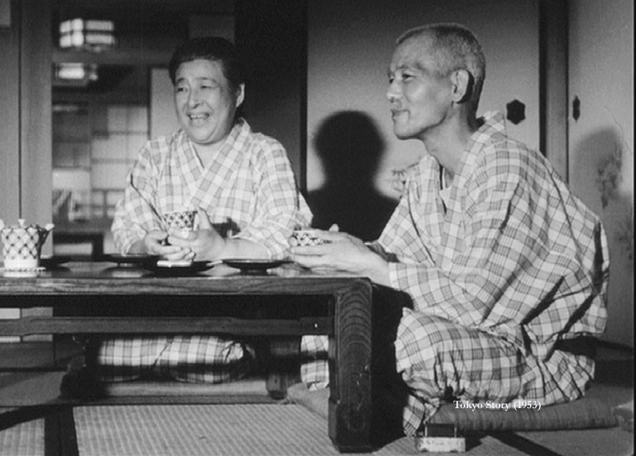
Ozu and Kurosawa in one frame each...
Film can be a mirror of culture.
Something like national cinemas? But can it be defined?
Tricky term “national cinema.” Needs words. I like the term “mirror of culture.” Graphic.
But different directors have a different view of the culture they film. Presumably there are extremes? Sometimes a quiet reflective cultural portrait. Sometimes a rambunctious rollicking riproaring one?
Something come to mind?
Hmmm.

Haaa!
How about Ozu and Kurosawa?
Ah. Tokyo Story and Seven Samurai?
Precisely.

_________
Voice-over
“National Cinema” is a term which scholars cannot agree on (Andrew Higson). It might be related to where the film is made, who made it, what it’s about and why it was produced.  “Cultural mirror”, is an image used by Harvie Conn to suggest that film reflects attitudes, values, philosophies and lifestyles.
...

Friday, June 6, 2008

9 word stories

Kambei tries to get Kikuchiyo to tell the story of the seven samurai.

...

Kikuchiyo: Well, there was a village, a mountain village, and the villagers were very poor and couldn’t grow much food, and they were frightened…


Kambei: Too much detail. Give me a plot summary in nine words.


Kikuchiyo: Nine words? Nine? Impossible.


Kambei: BME. Three words for the beginning, three words for the middle and three words for the end.


Kikuchiyo: I still say it’s impossible.


Kambei: Think of a magic square. A word square. A grid three squares by three squares. Put one word in each square.


Kikuchiyo: Three by three, I still don’t see…


Kambei: Top three squares, beginning: Bandits attack village. Middle three squares, middle section: Villagers hire samurai. Bottom three squares, ending: Samurai kill bandits.


Kikuchiyo: Ah.


Kambei: Try. Tell me the story of the seven samurai in nine words.


Kikuchiyo: Bandits attack village. Villagers hire samurai. Samurai kill bandits.


Kambei: That’s the skeleton, the structure, the framework. After that, you can hang meat on the bones.


~~~~~~~~

Voiceover


Hemingway is credited with being able to tell a story in six words. He came up with, "For Sale. Baby shoes. Never worn." 


The same principle of reductionism operates here, except that we have extended the six words to nine. In the interests of symmetry, and perhaps to ride the sudoku wave?


Down the X-axis we could place BME (Beginning, Middle, End) and across the Y-axis, categories like Agent, Action, Object.


With a bit of practice, you could find yourself talking like Joel or Ethan Coen pitching their latest story to a director.