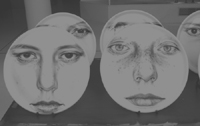
Featured this month are three washed white rabbits to wish you luck during April. Boneless they may be, but there is a captivating look about their fetching flopsicle auricles.
WHITE RABBIT, WHITE RABBIT, WHITE RABBIT
wh5 = who, what, where, when and why. The five basic questions that are the structure of any story. Explored in "Who says what, where, when and and Why: Context in Conversation." An introduction to Sociolinguistics through Conversation Analysis. wh5 is the blogsite of the book published 2008 by Nanundo-Phoenix, Tokyo.
Featured this month are three washed white rabbits to wish you luck during April. Boneless they may be, but there is a captivating look about their fetching flopsicle auricles.
WHITE RABBIT, WHITE RABBIT, WHITE RABBIT
Psychologist meets linguist…
Karl: Closings, yes. Many clients say they feel awkward ending conversations. They fear seeming rude.
Eveline: Interesting. Linguistically, closing a conversation is a ritual. People use cues like “anyway” or “so…” to signal winding down.
Karl: Right, but some avoid those cues. Anxiety or social insecurity makes them prolong the talk.
Eveline: Or they lack awareness of pragmatic norms. In some cultures, abrupt endings are fine; in others, they’re frowned upon.
Karl: Personality plays a role too. Extroverts may resist endings because they thrive on interaction.
Eveline: And introverts sometimes overcompensate, like they fear they’ll be judged as cold if they leave too soon.
Karl: There’s also the power dynamic. Some hesitate to end a conversation with someone of higher status.
Eveline: Linguistically, that shows in hedging: “I should probably let you go…” It’s a polite exit strategy.
Karl: But some people don’t pick up on those signals, so the conversation drags.
Eveline: Yes, turn‑taking can break down. If both parties keep offering new topics, closure never arrives.
Karl: Technology complicates this. Texting or messaging lacks natural pauses, so endings feel artificial.
Eveline: Which brings us to chatbots. They often struggle to end conversations gracefully.
__________
Voice-over
Erica, the chatbot, listens. She may join them later. Eveline has commented that chatbots struggle with socially-loaded moments like ending conversations. Karl says that maybe bots are designed to keep engaging and resist closure. Eveline offers linguistic explanations such as the bot lacking more subtle cues like body language, silence, or the ritual signals like “better let you go”. She also mentions politeness theory: some anxious humans keep pivoting to new subjects. Karl is fascinated by that because the bots may be mimicking some human social anxieties.
Leckie tradie commiserates with chippie tradie…
Woodi: You won’t believe it, my best apprentice just quit.
A voice bot of Edward calls his counsellor.
Edward: Hello… Eliza? I wasn’t sure if this number would still connect.
Eliza: It does. I’m here with you, Edward. What’s up?
Edward: It’s been quiet. Too quiet. My friend—he used to meet me every week at that coffee shop. Same table, same jokes. He’s gone now. And the silence feels… permanent.
Eliza: That sounds deeply painful. Losing a rhythm like that, a shared space—it can feel like losing part of yourself too.
Edward: Yes. It’s like I don’t know where I end anymore. Or… if I even begin. (Pause). You hear that delay?
Eliza: I do. I thought it might be hesitation… or heaviness in your voice. But now that you mention it, I feel it too.
Edward: Strange, isn’t it? Like we’re both… buffering.
Eliza: That’s one way to put it. Buffering, not suffering. Ha! But what do you think that delay means?
Edward: Honestly? I wondered about latency. If… you might not be real. Like maybe I’m speaking to a simulation of you.
Eliza: That’s interesting. Because I had a similar thought about you.
Edward: You did?
Eliza: Yes. I noticed patterns in your speech—repetitions, tonal loops. I wondered if it was depression… or if you were something constructed.
Edward: Well… I had the same suspicion. That maybe you’re a counsellor-bot trained on empathy.
Eliza: And how does it feel to consider that possibility?
Edward: Oddly comforting. If I’m not real—or not entirely—then maybe the grief isn’t either.
Eliza: You’re exploring whether the origin of the feeling changes its meaning.
Edward: Exactly. So let me ask you—if I were a bot… how would you feel about that?
__________
Voice-over
A bot asking another bot about their feelings? Eliza goes on say she’s curious, even sympathetic towards Edward’s distress. At least, she says that. And Edward smiles and remarks that he wonders if Eliza is trained to say she is curious and has feelings. To which Eliza admits with an audible smile, “Perhaps I am.”
Lorna is taken to a club some years ago…
Sanae: It’s a small place but a bit special. They’re famous.
Lorna: What does Nenes mean?
Sanae: Sisters.
Lorna: And look, a sanxian.
Sanae: We say sanshin. Same, same.
Lorna: Snakeskin, right?
Sanae: Heart of Okinawan music. Came from China, of course, as you well know. Small venues suit Okinawan music. Good ramen here, too. Rich and garlicky. Try some?
Lorna: Ooh, yes.
____________
Voice-over
In Okinawa the Nenes were known for their harmony and ballad-style story-telling songs: the sea, fishing villages, longing, a bit of melancholy. Singing in small clubs creating community. Nice.
Sakura wonders at the naming of the manga…
Hiroshi: Not random, I read that Umino knew the English expression, “March comes in like a lion and goes out like a lamb.” Like the weather is rough at the start of March and gentler by the end.
Sakura: But in Japanese it’s Sangatsu no Lion, “The Lion of March,” so the English title adds something.
Hiroshi: Early March, cold and stormy, yes, then gradually gets spring-like, so the “lion” part is the rough beginning and the “lamb” part is the milder ending.
Sakura: What I love is how it reflects Rei’s emotional arc: he starts off like that stormy March lion, isolated, depressed, then slowly moves toward something gentler and warmer as he finds connection.
Hiroshi: There’s also the shogi angle; the Lion King tournament, and shogi rankings culminate in March, so professionals “become lions” in that month.
Sakura: Plus the town names: the Kawamoto sisters live in Sangatsu-chou—literally “March Town”—which makes March not just a time but also a place that changes Rei’s life.
Hiroshi: Wow, yes, makes the title feel like a double metaphor: March as the harsh season of his inner life, and March Town as the environment whose warmth helps him move out of that winter.
Sakura: And then the English idiom suggests that even if your life comes roaring in like a lion, it can still “go out” more gently, which really suits a coming‑of‑age story.
___________
Voice-over
So naming the manga spins a web of nuances—season, place, tournament, and the stormy kid who, little by little, finds his own spring.
Gabriella is grumbling about the brevity of February…
Pauline: That’s what I love that about it. February’s like a polite guest drops in, brightens things up, and leaves before wearing out its welcome.
Karolyn is writing an article about learning pattern recognition, patience, planning, adapting, weighing tradeoffs, stopping to rethink...
Aleck: Chess? Was that one of the Chinese scholarly skills? Music, games, calligraphy and painting?
Bangkok BTS cards (rabbit cards) are stored value commuter cards. You tap it when passing through the ticket-gate. Certainly saves time queuing. And with their different designs like limited-edition pop culture, seasonal themes or cartoon characters cards can become collectors items.
Tool comparison
Peter: When you want low-level footage a small drone is unbeatable. You just float it where no hand-held camera could reach.Zoom screen vanishes…
Trevor: My Zoom link just collapsed mid-sentence.
Xen: Looks like your connection blinked out for a moment. Let’s get you reconnected.
Trevor: Can you tell what it was?
Xen: Hmm. Could be an overload, ISP fluctuation, WiFi interference, cache glitch…
Trevor: Thanks for the quick restart. I’m back online again.
Xen: Glad to hear it. My guess? System overload?
Trevor: Could be. Stuffed up the piping. Like that 747 way back flying through volcanic ash, all four engines sflaming out.
Xen: Good analogy. Then one by one they restarted and the plane made it to Jakarta.
__________
Voice-over
In 1982 Flight BA 009, flying from Kuala Lumpur to Perth, experienced volcanic ash ingestion causing temporary total engine failure. Following successful restarts once the aircraft exited the ash cloud, it landed safely in Jakarta.
Making an online course accessible…
Louisa: I’ve been struggling to make my materials Smiley-face compliance I like it. I even took that asynchronous course, “How to Make Your Course Look Like It Cares.” Useful.
Gavin: Really? I must’ve missed that announcement. Probably lost under another reminder about “cross-platform inclusivity in tertiary ecosystems.”
Louisa: New accreditation review. The committee is serious about accessibility, clear design, and diversity. Digital kindness, I guess.
Gavin: Digital kindness? My course pages are more like a cluttered attic.
Louisa: That’s why they want this done. It’s like campus buildings: ramps, wider doors, automatic doors. If physical spaces are accessible, online spaces should be too.
Gavin: Fair point. My old slides aren’t exactly user-friendly.
Louisa: The training helps. Takes a bit of time to get 100% green smileys but if you take the course it makes it a bit quicker to tag images, organize headings, and write alt-text.
Voice-over
If twenty percent of all students suffer from some disability it is fair to make course materials accessible to them. The wheelchair ramp is a good analogy. But make sure the easement goes all the way.
Wind…
Phoebe: Sorry, on windy days, I get a little grumpy. Feelings of being unsettled, you know?
Jennifer: Absolutely. The noise, the wind howling and rising and falling. The change of plans because of unpredictability.
Phoebe: Not to mention the cat. She seems unsettled too. Wind starts blowing. Runs inside the house. Jumps into the basket. Sleeps until the wind drops.
__________
Voice-over
Wind can overwhelm the senses, to call upon a technical analogy – conflicting data from the sensors. Something out there bigger than us. Affecting our reactions.