Friday, July 31, 2009

Cycling from Alaska to Tierra del Fuego

In the Plaza de Armas, Cusco, late in the afternoon.

...


wh5: Is that your bicycle? Could I ask you why it has two chains?


Goat: The wheels are too wide for a standard crank so I had to figure a way to transfer the drive to the rear wheels.


wh5: And you’re heading for?


Goat: We started in Alaska about 3 years ago, we're hoping to reach the bottom of South America by next spring.


Wh5: You travel with friends?


Goat: There are three of us.


wh5: And do you blog about this?


Goat: Sure, you can follow the progress at ridingthespine.com.

______________
Voice-over

A crowd gathers, questions are asked in Spanish. Goat (his real name) fields them deftly. His sister arrives having just flown in. Jacob says the crowds gather whenever they stop in a town square, and the usual questions come up. You can imagine they are mostly the usual what, when, where, who, why types, even if they sometimes lack an interrogative.


If you read Goat’s bio on the website here, you can’t but help admire his independence, inventiveness, curiosity. If more of us traveled this way, tourism might not have such a dark side.

...

Saturday, July 25, 2009

Advising on the Andes and alpaca

Francisco advises Tbn Tbn on what to take up the Andes.

...

Francisco: You wish to base yourself at Cusco.


Tbn Tbn: For a week.


Francisco: A week is good. You will have soroche, altitude sickness, when you arrive. But not for a week.


Tbn Tbn: It is cold?


Francisco: Señor, this is winter. Cusco is 3400 meters in the Andes. Could I suggest an alpaca?


Tbn Tbn: I have very little. I can carry my own bag.


Francisco: Señor, I suggest alpaca WOOL. A sweater, a scarf perhaps? And layers. You do not go to the Andes with little undies. You can get them in the market. Now, when you arrive, you will go light in the head. Your heart will beat the faster. You will breathe sometimes with difficulty. Take it easy and you will not suffer so much. Drink the coca tea there, it will help.


Tbn Tbn: I’ll rest the first day.


Francisco: What wisdom in one so young!


Tbn Tbn: I’m older than I look.


Francisco: No, Señor. You are not old. You will learn a lot from meeting the Uros on their totora floating islands on Titicaca. You will enjoy the hike to Machu Piccu. Trust me, you will.

__________________
Voice-over

“You will…” functions as part imperative, part prediction and part suggestion marker. It is a blended functional marker. Perhaps a portmanteau expression?


And the exchange on age follows a long tradition. One person admits to being old, it is polite for the listener to vigorously deny it…

Monday, July 20, 2009

Double entendre

...

Paul remarks on a stairway detail in a new Chinese Museum.


wh5: Striking piece of architectural detail, the way the stairs project unevenly.


Paul: What’s striking about it is that this one's likely to hit you on the head as you exit the restroom. Sticks out fair and square into the passageway.


wh5: Hmm. Not so clever.


Paul: I mean, these modern architects, they have often have a great artistic sense but they sometimes don’t think about how people’s behavior will impact on their design.


wh5: Come back in a year’s time, you’ll probably find the stairs are sawn off to a uniform length.


Paul: Only after someone lays themselves out.

________________
Voice-over

Consciously or unconsciously, we sometimes use words which emphasize our message. In talking about a hazardous protrusion which passersby could collide with, Paul turns “striking” into a double entendre and follows up with another, possibly subconsciously generated, in “impact.”

...

Sunday, July 19, 2009

Twittering Liberty

...

Carla visits Liberty Island and receives a tweet.


Liberty: Are you ready for your climb to the crown? It’s 354 steps up.


Carla: I can do it.


Liberty: And it’s 20 degrees hotter inside than out.


Carla: I have two bottles of water.


Liberty: Like your crown.


Carla: Excuse me, you aren’t Miss Liberty.


Liberty: How could I text holding a book and a torch?


Carla: Who are you, then?

____________

Voice-over


There is actually a Liberty Twitter site. It’s run by Liberty Island park rangers. Some liberty may have been taken with the synchronicity of what they actually twitter here.

...

Thursday, July 16, 2009

New York talk

Two New Yorkers bump into each other on the street.


How you bin?

Well, not so good you know, the economy…

Yeah, yeah. Anyway, you want a coaffee?

Naw, got no time. Gotta go woikout.

_________________
Voice-over

The sociolinguistics of New York English is fascinating.

The accent is colorful. Like “o” as in “coffee” becomes “oa”. Or the “er” as in “firm” becoming “oi”, or “r” in “park” being dropped, or "or" in "talk" becoming "tawk."

There aren’t many vocab items, maybe “standing on line” instead of “standing in line.”

Mainly it is the speed at which New Yorkers talk, the aggression with which they approach a conversation, which leaves non-New Yorkers wondering just when to break in and say their piece.

...

Monday, July 13, 2009

Starting a NGO

...

S. talks about founding a NGO in Northern Thailand.


S: I went there originally as a pastor. I wanted to start a church.


wh5: And people came?


S: Oh, they came. Many were refugees. They came with traumatic life problems.


wh5: Like?


S: In Burma….loggers and the army come to a Karen village, they find the village headman, grab his daughter, beat and rape her, throw her into a burning house, the village cannot fight back, the villagers become the slaves of the loggers and environmental exploiters. If they can, the Karen escape across the border, into Thailand.


wh5: A terrible story.


S: I realized I couldn’t just pray or preach parables. It was more helpful for me to listen and take them in. Soon the church was full of refugees camping out in my house, which was also my church. I did what I could, we didn’t have a lot of money, but it didn’t take long for me to realize (1) I didn’t have the resources to carry on this permanently, and (2) God was telling me to find a way to recognize Him by helping these people.


wh5: Did you find a way?


S: So I started an NGO.


wh5: Political?


S: Basically an aid organization. Just my family at first, but now we have a staff, we can help with their needs. Essentials like clothing, medicines, food and cooking pots, plastic sheets, mosquito repellent.


wh5: How do you get funding for it?


S: Donations from churches. Foundations.


wh5: The U.S.?


S: A dozen different countries.


wh5: I think it was Bill Clinton who said that “people are inherently generous, that giving makes you feel good, and that the only thing most of us are looking for is an opportunity to make a difference.”


S: And Mother Teresa who said, “The poor are wonderful. The poor give us so much more than we give them.”


wh5: Are all your helpers Christian?


S: By no means, no. Muslims, Buddhists, Christians, they all work alongside each other.

________________

Voice-over

Getting the message across about atrocities can be done in several ways.


We can present pictures of terrible scenes.


We can breathe fire and say loudly that something is unthinkable or shocking, we can urge that something must or should be done or it's essential, crucial, imperative, that something be done.


We can appeal to the listener’s sense of morals, “We can’t allow this to continue, we can’t just stand by and watch, we can’t just close our eyes to this.”


Or we can take a low-key, pragmatic, non-ideological, religio-tolerant approach such as S. does and set out the situation plainly and let the facts speak for themselves. Something stirs inside us and we feel we need to help. This low-key approach makes us think we initiated the assistance by ourselves.

...
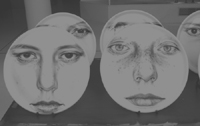
Tuesday, July 7, 2009

Migration and alternative identity

The stories of two non-traditional Norwegians:

...

My name is Rachel. I’m 30. My father was from Morocco and my mother was Norwegian. I was born in Norway but when I was two, my parents split up, and my father took me back to Morocco. He kidnapped me actually, because my mother chased after him and tried to get me back. She had two attempts, the second time with help from the Norwegian embassy and her brother, and finally she managed to grab me while everyone was napping and escaped back to Norway. She had to change her name and her address and I grew up with her. But recently I found my family in Morocco. They are Muslim. They treated me very kindly, especially my foster mother. I stayed for three months and although it would be difficult for me to be a Muslim, I wonder now what my life would have been like growing up in that big extended Moroccan family.


My name is Nguyen. I’m 52 now. I was born in South Vietnam but my parents were killed when the North Vietnamese took over Saigon. My brother and I wanted to escape but it cost more money than we had to become boat people. Anyway, we heard there was a good chance we would drown because the boats often sank. So we learned how to build our own boat. We learned about sea-worthy design and engine repair. Finally we could escape to Hong Kong and a refugee camp and enter Norway. I work here as boat builder now, it’s good, but I sometimes like to go back to Vietnam.

__________
Voice-over

You might think that Norway is populated exclusively by Thor Heyerdahl type men and Liv Ullman type women. But Norway seems receptive to migrants. There is an intercultural museum including artifacts from immigrant groups, in fact at present, there is an exhibition of six world religions: Sikhism, Judaism, Islam, Christianity, Hinduism and Buddhism, brought to Norway by migrants. Rachel feels lucky she did not grow up in Morocco but is learning Arabic and dreams of having another life. Nguyen created for himself another life and speaks Norwegian but sometimes thinks of where he came from.

...

Sunday, July 5, 2009

Defining culture

...

A boy asks his uncle a question.


Boy: Culture?

Uncle: Culture, yes. The beliefs and behaviors of a society.

Boy: What are beliefs and behaviors and societies?

Uncle: Oh, well. Yes. Let’s turn it around. Society is people. Beliefs are what they think. Behaviors are what they do.

Boy: People thinking and doing.

Uncle: Like a man who thinks about God so he goes to church on Sundays.

_____________________
Voice-over

Grownups can handle abstract definitions. For children, until their cognitive apparatus is in place, definitions need to be phrased in simple concrete words, preferably accompanied by examples.


And better if the main noun comes first.

...